
📋 Table of Contents
Disk Brakes vs. Drum Brakes: Safety in the Rain When Riding in Vietnam: As we move into the heart of the 2026 riding season, the landscape of Vietnamese motorcycling is shifting. With Hanoi’s new Low-Emission Zones (LEZs) officially piloting in Hoan Kiem this July, and a surge in high-torque electric models like the Honda UC3 hitting the streets, the way we stop is just as important as how we go.
But whether you are piloting a classic “thumper” through the Ha Giang loops or a silent electric commuter through the flooded streets of Binh Thanh, one ancient enemy remains constant: The Rain.
When the sky opens up in a tropical downpour, the coefficient of friction between your brake pads and your wheels changes in a heartbeat. Understanding the mechanical soul of your braking system—Disk versus Drum—is the difference between a controlled stop and a “trời ơi” moment in the mud.
The Molecular Battle: Why Water Changes Everything
- To understand why your bike feels different when it’s wet, we have to look at the physics of the Hydrolock Effect. In dry conditions, braking is a simple conversion of kinetic energy into thermal energy (heat). Your pads grip a surface, friction occurs, and you slow down.
- In the rain, a third element enters the chat: a microscopic layer of water. If your braking system cannot evacuate this water, the pads essentially “hydroplane” over the metal surface rather than gripping it. This is why “brake lag”—the terrifying one-second delay when you squeeze the lever and nothing happens—is so common in the rainy season.
Disk Brakes: The Open-Air Squeegee
In 2026, almost every performance-oriented motorcycle, such as the CFMOTO 450MT or the Himalayan 450, utilizes disk brakes on at least the front wheel. There is a scientific reason why the “Open System” of a disk is superior for the monsoon.
1. Centrifugal Evacuation
- As your wheels spin at $60 \text{–} 80 \text{ km/h}$, a disk rotor acts like a centrifuge. Water, mud, and grit are naturally flung outward and off the rotor. Unlike a drum, which is a closed box, the disk is “self-cleaning.” Every time you apply light pressure to the lever, the brake pads act as a squeegee, wiping the rotor dry in milliseconds.
2. Ventilation and Heat Management
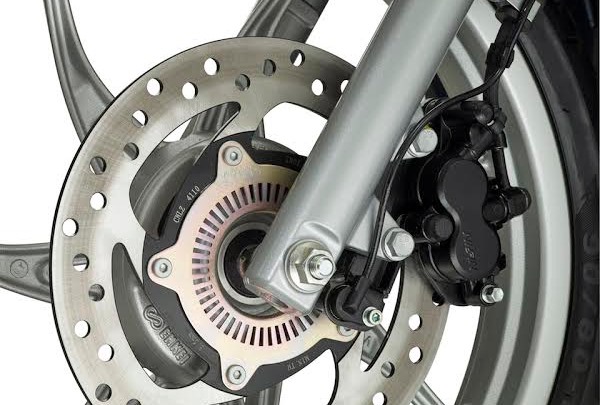
The holes you see drilled into modern rotors (ventilated disks) aren’t just for aesthetics. They serve two vital roles in the rain:
- Gas and Water Dissipation: They provide a path for steam (created when hot pads hit cold water) and liquid water to escape the contact patch.
- Thermal Stability: Because the system is open to the air, it cools down rapidly. This prevents “brake fade” on long descents from the O Quy Ho Pass, where constant braking would otherwise boil your brake fluid.
3. Hydraulic Precision (The Lever Feel)
- Disk brakes use a hydraulic system—a non-compressible fluid (DOT 4 or 5.1) that transfers your finger strength directly to the caliper. In the rain, when traction is low, this Modulation is life-saving. You can feel exactly when the tire is about to lock up, allowing you to “threshold brake” without the assistance of ABS (though in 2026, we always recommend ABS).
Drum Brakes: The Enclosed Veteran
You will still find drum brakes on the rear of many commuter bikes and the “backpacker” Honda Wins. While often dismissed as “ancient tech,” they have specific characteristics that make them a unique challenge (and occasionally a benefit) in Vietnam.
1. The Sealing Paradox
- Drum brakes are enclosed systems. In a light drizzle, this is an advantage because the internal “shoes” stay dry while the rest of the bike gets soaked. However, in the 2026 Vietnam reality—where street flooding can reach the axles—this enclosure becomes a trap.
- Once water enters a drum brake (through the spindle or cooling vents), it cannot escape. It sits inside the “bowl,” turning your braking surface into a lubricated slip-and-slide. If you’ve ever ridden through a flood and found you had zero rear brakes afterward, this is why.
2. Self-Energizing Effect
- Drum brakes have a “leading-shoe” design that actually pulls the shoe into the drum as it grips. This provides a lot of “bite” with very little foot pressure. In the rain, this is actually dangerous. On a slick road, this self-energizing bite can cause the rear wheel to lock up instantly, leading to a “fishtail” or a low-side slide.
3. Maintenance and the “Squeak”
If you hear a high-pitched squeal from your rear wheel after a rainstorm, it’s likely “glazing” or grit trapped inside the drum. Because you cannot see the shoes without taking the wheel off, many riders ignore drum wear until it’s too late.
- 2026 Tech: The Rise of Regenerative Braking
- A new factor in the 2026 safety equation is Regenerative Braking, found on the new wave of electric bikes like the VinFast Feliz II and Honda UC3.
- For the rain, “Regen” is a secret weapon. Because the motor itself acts as a brake by reversing polarity, it provides a smooth, non-mechanical deceleration that doesn’t rely on friction.
- No Mechanical Lockup: Regenerative braking is less likely to “snap” the wheel into a lockup compared to a mechanical drum brake.
- Energy Recovery: In the “stop-and-go” chaos of a rainy Hanoi afternoon, you are actually recharging your battery every time you slow down for a bus.
The “Vietnam Factor”: Why Surface Matters
- Safety in the rain isn’t just about the hardware; it’s about what the hardware is gripping. In Vietnam, you are fighting three specific “rain monsters.”
1. The “First 10 Minutes” Grease
- In Hanoi and Saigon, roads are often coated in a fine layer of dust and leaked diesel. When the first drops of rain fall, they don’t wash this away; they turn it into a chemical “butter.” During the first 10 minutes of a storm, your disk brakes are actually safer because their high clamping force can “cut through” the grease better than a drum.
2. The Painted Line Trap
- White and yellow road markings in Vietnam (especially pedestrian crossings) become ice-slick when wet. Rule for 2026: Never apply your front disk brake while your tire is on a painted line. The sudden “bite” of a disk will wash the front end out instantly.
3. Hidden Potholes in Floods
- If you are riding through standing water, your drum brakes are likely compromised. In this scenario, rely on your front disk brake, but use it with 20% less force than usual, as the water hides potholes that can “jar” your steering if you are braking hard.
2026 Safety Trend: AI and ARAS
If you are renting a premium bike from Duy Anh Motorbikes in 2026, you may have access to Advanced Rider Assistance Systems (ARAS). These use ultrasonic sensors or cameras to “see” the rain.
- Rain Mode: Many bikes now have a dedicated “Rain” throttle map. This softens the initial “bite” of your disk brakes electronically, preventing accidental lockups on slippery surfaces.
- Emergency Brake Assist: In a critical moment, the AI can modulate the hydraulic pressure faster than a human, keeping the bike upright even if you “panic-grab” the lever.
- Survival Guide: Maintaining Your Brakes for a 2,000km Loop
Before you head out on the Ho Chi Minh Trail this season, perform this 2026-spec brake audit:
- Disk Pad Thickness: Look at your calipers. If the friction material is thinner than a 2,000 VND coin, replace them. Wet sand from mountain roads will eat through thin pads in a single day.
- Fluid Color: If your brake fluid looks like dark soy sauce, it’s contaminated with water (which happens easily in high humidity). It needs a “flush and bleed” to ensure your lever doesn’t go “mushy” on the mountains.
- Drum Adjustment: If you have a rear drum, ensure there is about $2 \text{–} 3 \text{ cm}$ of “free play” in the pedal. If it’s too tight, the heat from a long descent will cause the drum to expand and “lock” the wheel while you are riding.
The Final Verdict: Which is Safer?
- For 2026, the answer is categorical: Disk Brakes are the superior safety choice for the Vietnamese rain.
The ability to clear water, dissipate heat, and provide precise “feel” makes them the gold standard for anyone heading into the mountains or navigating the urban LEZs. However, the best braking system in the world is useless if the rider doesn’t respect the rain. - Pro-Tip: In the rain, your braking distance doubles. If you usually brake 10 meters before a turn, start 20 meters back. Use a 70/30 ratio (70% front disk, 30% rear) to keep the bike’s geometry stable.
- Stay dry, stay upright, and remember: in the North, the clouds are beautiful, but the road is a teacher—and she doesn’t like sudden movements.