

📋 Table of Contents
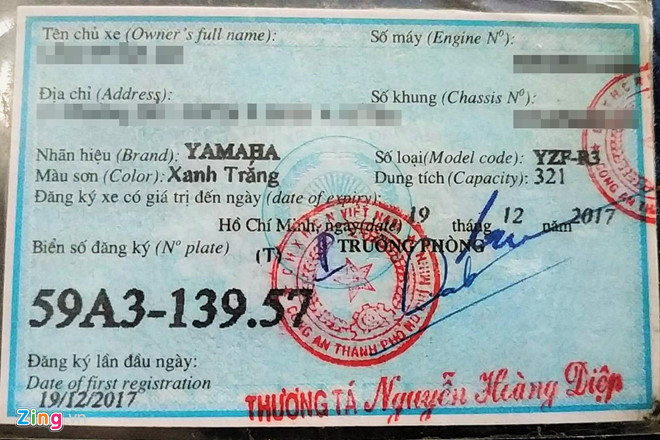
How to Read a Vietnamese Motorbike Registration (The Blue Card): For every serious rider, the Blue Card (known locally as Cà Vẹt) is the most important piece of paper you will carry after your passport. It is the “birth certificate” of your motorcycle. In 2026, with stricter roadside enforcement and digital integration (VNeID), being able to verify the data on this card is a vital skill.
When you rent a high-performance bike like the CFMOTO 450MT, Himalayan 450, Yamaha NVX155, Honda Wave or Honda NX500 in Hanoi, you must ensure the technical details on the card match the machine beneath you. Here is your field-by-field translation and guide.
Technical Breakdown of the Blue Card Fields
- Số máy (Engine Number): * What it is: A unique code stamped onto the engine block.
- Why it matters: Police will cross-reference this during a deep inspection. If this doesn’t match the card, the bike is considered “illegally modified” or stolen.
- Số khung (Chassis/VIN Number): * What it is: The vehicle identification number stamped on the frame (usually near the steering head).
Why it matters: This is the primary identifier for the bike’s identity.
- Biển số đăng ký (License Plate Number): * What it is: The number on the metal plate at the back of the bike.
- The 2026 Rule: Since late 2023, Vietnam has moved to “Identification Plates” (Biển số định danh). The plate is now linked to the owner’s ID, not just the bike.
- Nhãn hiệu (Brand): * Examples: Honda, Yamaha, CFMOTO.
- Số loại (Model/Type): * Why it matters: This confirms the specific model. For serious riders, ensure this reflects the actual model (e.g., “CB500X” or “450MT”) and not a generic placeholder.
- Dung tích (Displacement/Capacity): * The Critical Number: This is where you see the “cc” (e.g., 471cm³ for a CB500X).
- Serious Note: This field determines if you need an A1 or A2 license. If this number is over 175, and your IDP doesn’t have an A2 stamp, you are legally at risk.
The “Scale of Legitimacy” in 2026
In the professional rental market, not all Blue Cards are created equal.
- The Original: Rental shops usually keep the original Blue Card in their safe and provide you with a notarized/certified copy accompanied by a rental contract.
- The Verification: When starting in Hanoi, a professional shop will walk you through the bike, showing you exactly where the
Số máy and Số khung are located so you can verify they match the card yourself.
Why Starting from Hanoi Protects Your Paperwork
- Registry Accuracy: Professional fleets in Hanoi are registered under legitimate business entities. This means the “Blue Card” is backed by a real company, making it much easier to verify at police checkpoints in Ha Giang or Sapa.
- Digital Integration: In 2026, many legitimate rental bikes are integrated into the VNeID system. Starting in Hanoi ensures you are renting a bike that is “on the grid” and legally recognized.
- Expert Support: If a police officer questions the authenticity of your registration in a remote village, having a professional Hanoi-based partner to call provides immediate legal resolution.
Rider’s Checklist: 3 Things to Check in Hanoi
Match the CCs: Does the Dung tích (Capacity) on the card match your license category (A1 or A2)?
- Valid Dates: Check the “Ngày đăng ký” (Registration Date) to ensure the bike is part of a modern, well-maintained fleet.
- Physical Match: Ask the mechanic to show you the Số khung (VIN) on the frame. If it’s scratched off or doesn’t match, do not take the bike.
- Bottom Line: The Blue Card is 50% of the bike’s value and 100% of your legal safety. Understand the fields, verify the numbers in Hanoi, and ride with the confidence that your machine is as legitimate as your skills.
Good Luck!