
📋 Table of Contents
The 450MT vs. Himalayan 450: Battle of the Mid-Weights: The mid-weight adventure crown is a battle between two design philosophies. We compare the twin-cylinder CFMOTO 450MT against the single-cylinder Royal Enfield Himalayan 450.
The Mid-Weight Revolution: The Changing of the Guard
- The global middleweight adventure sector has officially entered its golden era. For years, riders planning an expedition through the extreme topography of Northern Vietnam were forced to make a dramatic compromise: they had to choose either a lightweight but underpowered 150cc dual-sport that struggled on the highways, or a massive, 200kg+ twin-cylinder machine that turned technical off-road trails into a grueling physical workout.
- The industry has solved this problem by creating the 400–500cc Middleweight Class. These machines offer the structural geometry, suspension travel, and long-distance comfort of full-scale global tourers, but with physical weights and footprints that match the realities of Asian riding tracks.
- The battle for supremacy in this sector has narrowed down to a conflict between two opposing engineering philosophies: the CFMOTO 450MT and the Royal Enfield Himalayan 450. While both bikes share almost identical displacements and are aimed squarely at the same terrain, their mechanical hearts are completely different.
- This detailed analysis contrasts their engine dynamics, chassis architecture, suspension execution, and electronics to help you choose the perfect partner for your expedition.
The Royal Enfield Sherpa 450: The High-Tech Thumper
- The Himalayan 450 marks a massive leap forward for Royal Enfield, featuring their first modern liquid-cooled engine, dubbed the Sherpa 450. This single-cylinder layout produces a massive wave of immediate torque low down in the rev range.
- The physics of a large single piston allow it to deliver power in distinct, heavy pulses. When you are crawling up a slippery, muddy track at low speed, the Himalayan’s engine acts like a slow, deliberate tractor. Between each combustion stroke, the rear tire has a split-second to grab traction against the soil before the next power pulse arrives. This makes the Himalayan incredibly easy to manage on technical terrain where low-speed tractability is paramount.
The CFMOTO 450MT: The Mini-V-Twin Symphony
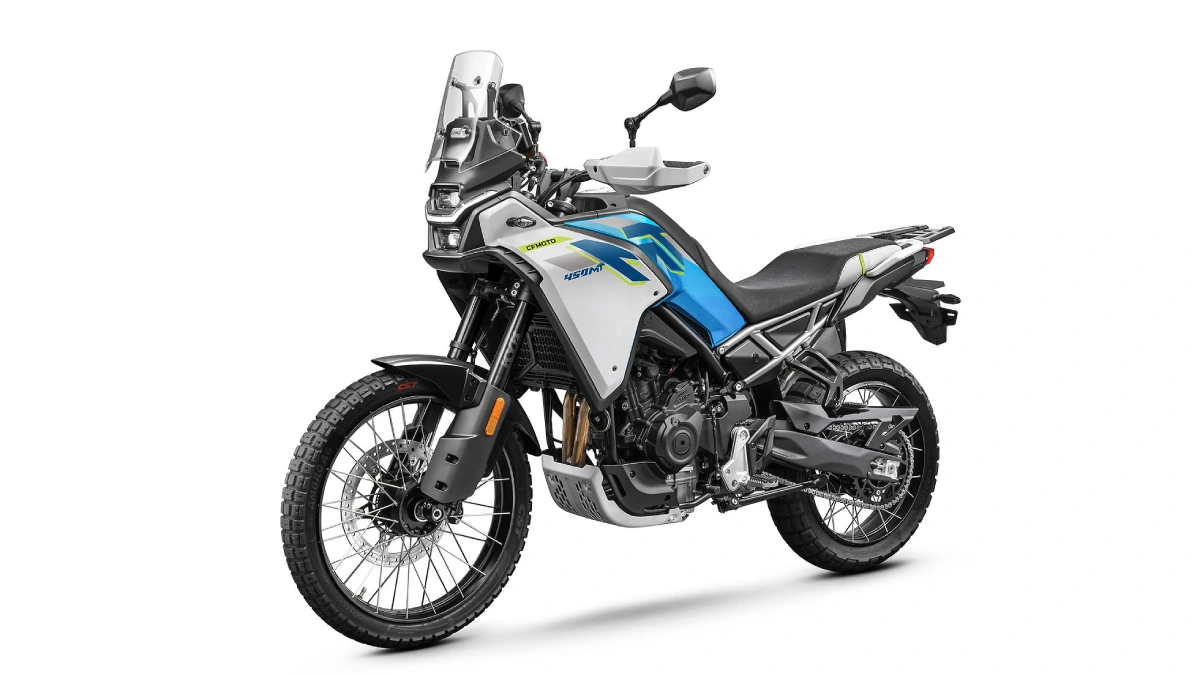
CFMOTO approached the problem by using a parallel-twin engine utilizing a 270-degree crankshaft configuration. A 270-degree firing order mimics the exact power delivery and exhaust note of a 90degree V-Twin engine.
Instead of the continuous, thumping drone of a single, the 450MT delivers its power in an asymmetric layout that offers the best of both worlds: crisp low-end engine traction and a smooth, high-revving top end.
On the open asphalt stretches of the National Highways, the twin-cylinder configuration is vastly superior. It cancels out the high-frequency secondary engine vibrations that can cause a rider’s hands and feet to go numb after two hours of sustained highway cruising.
Suspension Geometry and Chassis Dynamics
When the asphalt ends and the karst rocks begin, your speed is entirely limited by your suspension’s ability to keep your tires pinned to the earth.
The CFMOTO 450MT: Adjustability King
- The 450MT is built on a high-tensile steel tube cradle frame paired with a fully adjustable KYB suspension system. The inverted front forks offer 200 mm of wheel travel and feature manual damping clickers at the top of the fork caps, allowing you to tune your compression and rebound settings on the fly.
- The bike features a dedicated 21-inch front wheel and an 18-inch rear wheel, which is the gold standard for off-road tire choice. With a generous ground clearance of 220mm, the 450MT can hop over deep ruts and sharp logs without touching its belly pan. The overall chassis feel is slim, nimble, and highly reminiscent of a dedicated rally raid machine.
The Himalayan 450: The Planted Freight Train
- The Himalayan 450 utilizes a twin-spar steel frame that incorporates the engine as a stressed member, paired with non-adjustable Showa Separate Function Forks delivering 200 mm of travel.
- While it lacks the fine-tuning adjustment clickers of the CFMOTO, the out-of-the-box damping tune from Showa is magnificent. The Himalayan has a longer wheelbase (1,510 mm), which makes it feel incredibly stable, planted, and secure. It tracks straight through loose gravel like a freight train, absorbing massive hits with ease.
- However, its ground clearance sits slightly lower, and its dry weight scales at approximately 181 kg—making it roughly 6 kilograms heavier than the 450MT. In tight, back-and-forth mountain hairpins, the Himalayan requires slightly more physical lever input to transition from side to side.
The Tech Integration and Digital Dashboards
Both manufacturers have embraced the modern tech standard, providing high-definition displays and advanced rider aids.
The Himalayan’s Circular TFT: Royal Enfield features a unique, circular full-color TFT display that integrates directly with Google Maps via smartphone casting. This allows for full moving-map navigation directly on the main screen, a massive luxury for riders exploring unfamiliar routes without a separate GPS unit.
The CFMOTO’s Rally Dash: CFMOTO uses a large, vertical 5-inch TFT dash that resembles a roadbook holder from a Dakar race bike. It features integrated over-the-air (OTA) updates, Bluetooth connectivity, and dual-channel ABS that can be disabled to the rear wheel with a single, dedicated button on the handlebars—vital for executing brake-slides on dirt tracks.
The Verdict: Matching the Motorbike to Your Itinerary.
The choice between the CFMOTO 450MT and the Royal Enfield Himalayan 450 is a choice between two distinct riding styles.
Choose the CFMOTO 450MT if:
Your route is a true 50/50 mix of high-speed pavement and technical off-road trails. You value a light, flickable chassis, adjustable suspension clickers, and want a bike that can cruise at high speed without vibration fatigue. It is the perfect modern tool for the dynamic explorer.
Choose the Royal Enfield Himalayan 450 if:
Your journey focuses on continuous long-distance touring, high-altitude climbs, and loaded two-up travel. The steady torque of the Sherpa engine, the rock-solid stability of the longer chassis, and the integrated full-screen Google navigation make it an incredibly comforting companion for long days in the saddle.